Insights from Kali P. Chaudhuri, CPA, EA, MBA, Partner at Hara Chaudhuri Chavez PC
Most wellness brands think of the federal R&D tax credit as something for pharma companies and tech firms. It isn't. If you pay a U.S. partner to run clinical research on a new or improved product, part of that spend may come back to you as a dollar-for-dollar reduction in your tax bill, subject to limits.
The rules also changed a lot in the past 15 months. A new tax law restored the immediate deduction for domestic research, the IRS rewrote the claim form, and the Tax Court weighed in on how research contracts should be read. In a recent Radicle Science webinar, Kali Chaudhuri walked through what those changes mean for companies that outsource research. Here are seven things from that session that most brands in the wellness industry don't know.
1. Outsourced research counts, and compares favorably to in-house
You don't need your own lab or research staff to claim the credit. Under IRC §41(b)(3)(A), 65% of what you pay a non-employee to perform qualified research on your behalf counts as a qualified research expense (QRE).
The 35% reduction is meant to strip out the contractor's overhead and profit. But compare that with building the capability yourself. In-house, only three kinds of cost qualify: taxable wages for people doing or directly supporting the research, supplies used up in the research, and computer use such as cloud hosting. Benefits, rent, equipment and recruiting never count.
What it means for your brand: Paying a U.S. research partner can turn a large share of a study's cost into credit-eligible spend, with no hiring, payroll or infrastructure to build first.
2. Products already on the shelf can still qualify
Research done after commercial production is excluded from the credit, so many brands assume an existing product is off the table. Not necessarily. The four-part test for qualified research is applied separately to each "business component," which includes a product, formula or technique.
A reformulation, a new dose, a new delivery form, a new ingredient combination or a study of a new health outcome aligned with a change in formulation can count as its own project, even when an earlier version is already selling. The research has to aim at a new or improved function, performance, reliability or quality, and resolve real technical uncertainty through experimentation.
What it means for your brand: Your next product improvement may be a qualifying research project, not just a line extension.
3. The research deduction is back
From 2022 through 2024, companies had to spread domestic research costs over five years instead of deducting them right away. The One Big Beautiful Bill Act, signed July 4, 2025, changed that. New IRC §174A lets businesses deduct domestic research and experimental costs in the year they're paid, for tax years beginning after December 31, 2024. Businesses can also choose to amortize those costs over 60 months or more.
The credit and the deduction now work together again, under a coordination rule in §280C(c). You either reduce your deduction by the amount of the credit, or elect a reduced credit on a timely filed original return. For a C corporation, the reduced credit is 79% of the full amount.
What it means for your brand: For U.S.-based research, the combined first-year benefit is generally larger than it was under the 2022-2024 rules.
4. Where the research happens matters twice
Research performed outside the United States is excluded from the credit entirely. It also stays under the old rules for deductions: foreign research costs must still be amortized over 15 years.
So the same study can produce very different tax results depending on where it is run:

What it means for your company If you're comparing research partners on price, factor in the tax treatment. An offshore study that looks cheaper on paper can cost more after taxes.
5. The contract decides who gets the credit
Generally only one party to a research agreement can claim the credit: the company paying for the research or the firm performing it. If the agreement is poorly drafted, neither may be able to. As Kali put it in the webinar, read the contract, not the invoice.
Under IRS regulations (Treas. Reg. §1.41-2(e)) and the credit's general rules, your payments count as contract research only when:
1. The agreement is signed before the research begins.
2. The research is performed on your behalf, and you have a right to the results. Exclusive rights aren't required.
3. You owe the payment whether or not the research succeeds. Success fees or refund clauses can make payment contingent, and contingent amounts don't count.
4. The work itself meets the four-part test for qualified research.
5. The work is performed in the United States.
Courts continue to tighten how these terms are read. In Smith v. Commissioner (T.C. Memo. 2026-50), the Tax Court upheld the IRS’s funded-research regulations and decided the case contract by contract, based on payment terms and who kept rights to the results.
What it means for your company: Review payment terms, success fees and IP or license rights with your tax advisor before you sign, not at tax time.
6. Startups can use it against payroll taxes
A young company may have little or no income tax to offset. The credit can still help. A qualified small business, one with under $5 million in gross receipts and no gross receipts before the most recent five-year window, can elect to apply up to $500,000 of the credit each year against employer payroll taxes (IRC §41(h)).
That $500,000 splits into up to $250,000 against the employer share of Social Security tax and up to $250,000 against employer Medicare tax.
What it means for your brand: Emerging brands investing in clinical evidence early may get a cash-flow benefit years sooner than waiting for taxable income.
7. The IRS wants more documentation, starting this tax year
Under final instructions released in February 2026, Section G of Form 6765 is required for tax years beginning after December 31, 2025. It asks for detail at the business component level, meaning product by product, including how QREs split among wages, supplies, computer use and contract research.
There are exceptions. Qualified small businesses electing the payroll tax offset are exempt, as are filers with total QREs of $1.5 million or less and gross receipts of $50 million or less. Refund claims must still identify the business components, research activities and people involved.
For contract research, Kali recommends getting activity details from your contractor, such as reports tied to each business component, and separating qualifying work from non-qualifying work on invoices before applying the 65%.
What it means for your company: A research partner that delivers structured protocols and study reports for each product makes your claim much easier to support.
How the numbers can work: an illustration
Kali shared this example of contract research in an Alternative Simplified Credit (ASC) claim. A company pays a U.S. research firm $400,000 under a fixed-fee agreement signed before the work began. The company keeps rights to the results and owes the fee whether or not the research succeeds. $100,000 of the invoice covers non-research work, so it is carved out first.
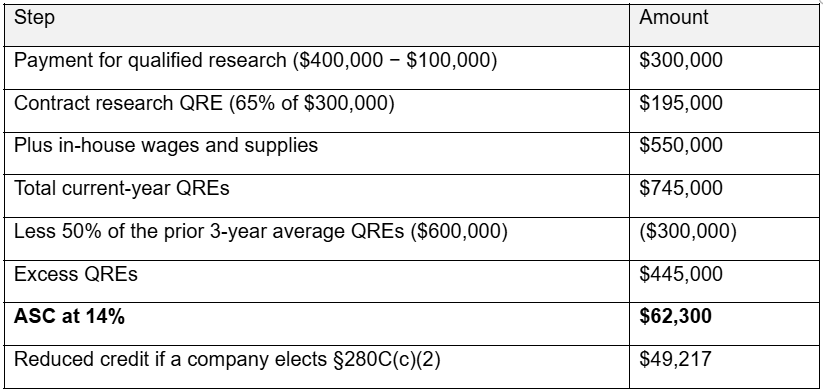
Illustrative figures only. If the agreement had made payment contingent on a successful result, the $300,000 would not have counted at all.
What doesn't qualify
The credit is for technical research, not marketing. These are excluded even when they feel like research:
• Market research, consumer surveys and other social science studies
• Routine testing and quality control
• Adapting or duplicating an existing product
• Research funded by someone else
• Research conducted outside the U.S.
A brand, IP or a marketing claim doesn't make research eligible on its own. The study has to start from a technical question.
Give your R&D some credit
A randomized, placebo-controlled trial that tests something new is the kind of research the credit was written for. Radicle Science runs exactly that kind of study for supplement, ingredient, food and beverage, and pet brands:
• U.S.-based trials. Participants enroll from home across the country, and the work is performed in the United States.
• Built around a technical question. Each trial can be designed to test a new formulation, dose, delivery form, ingredient combination or health outcome.
• Months, not years. Run the trial, see the outcome and potentially claim the credit when the costs are incurred if research qualifies.
• Measured outcomes, not opinions. Studies draw on 100+ physical and digital biomarkers..
• Independent evidence. Third-party results carry weight with retailers and regulators, and the study documentation supports your records.
Thinking about your next product improvement? Connect with the Radicle Science team at sales@radiclescience.com. For questions about the Federal R&D Tax Credit and potential eligibility, reach out to Kali Chaudhuri, CPA, EA, MBA at Kali.Chaudhuri@hccpas.com.
This article is for general information only and is not tax advice for any specific situation. Each study is evaluated on its own and must meet the four-part test for qualified research. Confirm eligibility with your tax advisor. Kali P. Chaudhuri, CPA, EA, MBA, is a Partner at Hara Chaudhuri Chavez PC in San Diego, California. HCC does not receive any commission or referral fee.
Watch the full webinar: Wellness R&D: Could Your Clinical Research Qualify for a Federal Tax Credit?