What is the role of clinical evidence in wellness innovation? It is not the endpoint of a product journey. It is the infrastructure that makes better decisions possible.
Health and wellness companies make high-stakes decisions every day. Which product deserves capital. Which claim can stand up to scrutiny. Which consumer segment is worth pursuing. Which market has real growth potential. Which idea should be scaled, reformulated, or retired.
Too often, those decisions still rest on trend reports, competitor movement, consumer anecdotes, and internal conviction. Those inputs matter. But they can also create false confidence. If a product team hears the same assumption often enough, it starts to sound like fact.
Clinical evidence in wellness innovation changes that. Most organizations evaluate research based on whether a study produced a result. That framing misses the more important question: how evidence is generated in the first place, and whether it is designed to make the next business decision sharper.
Clinical Research as a Wellness Strategy, Not a Checkbox
Clinical research is often treated as a final checkpoint. The product is built. The claim is selected. The brand runs the study to validate what it already wants to say.
That is too narrow.
A study can answer whether a product worked in a defined population under defined conditions. But the more strategic value sits deeper in the data. Who responded. Which outcomes moved. Which claims are supportable. Which signals were weaker than expected. Which sub-population told a different story than the average.
The top line matters, but it is not the whole story. In wellness, the question is rarely only, "Did this product work?" The better question is, "For whom did it work, under what conditions, and what does that tell us about the next decision?"
That is where evidence stops being a checkpoint and becomes a cycle of learning. Trial to insight. Insight to pipeline. Pipeline to the next trial. That is the foundation of evidence-based product development. Not a test to pass, but the mechanism that tells you what to build next.
How Clinical Evidence Reduces Innovation Risk and Capital Waste
Every product decision is a bet. Evidence does not eliminate risk. It makes the risk visible.
For executives, that visibility matters. Companies have limited capital, limited attention, and limited time. They cannot fund every product idea. They cannot chase every category trend. They cannot build a brand strategy on assumptions that no one has tested.
A strong evidence base helps leaders compare opportunities with more discipline. It shows which products deserve more investment, which formulations need refinement, which claims are defensible, and which consumer segments are most likely to benefit.
That is capital allocation with a signal instead of a guess. Instead of spreading investment evenly across possibilities, leaders can direct resources toward the products, claims, and markets with the strongest evidence behind them. That is risk management.
Building Confidence Through an Evidence Architecture
One study can be valuable. Multiple studies reveal patterns.
A single trial can show what happened in one product, population, and moment. A portfolio of trials can show what happens repeatedly, across different participants, outcomes, formulations, doses, and use cases.
That is the difference between a datapoint and an evidence architecture. A one-time study answers one question but should yield many more. The questions generated then become what is addressed through the next study design Therefore, a system of studies tells you which questions to ask next.
When evidence generation is built into the clinical research wellness strategy, not bolted on after the fact, companies start to see what repeats. Which benefits hold across populations. Which segments respond more strongly. Which product assumptions collapse under scrutiny.
That is how evidence builds executive confidence. It replaces assumptions with data you can act on.
Representation: Why Broader Data Builds Better Strategy
A systems-level approach to evidence generation does not ask only for more data. It asks for broader, more representative data.
That matters because wellness products are used by real people with real lives. Not narrow lab populations, not idealized consumers. Real participants, with different baselines, habits, needs, and expectations.
Representative data helps companies avoid the most expensive kind of assumption: believing that one population reflects the whole market.
It also shows where demand and efficacy actually overlap, which is not always where the market looks biggest. Clinical evidence in wellness innovation answers the question a category trend cannot: does your product create measurable value for this population, or are you just following the noise?
That is market strategy built on proof. Not a category trend. Not a mood board. Evidence.
Pipeline Intelligence: What Clinical Trials Reveal About Your Wellness Innovation Pipeline
The average can bury the most useful business insight.
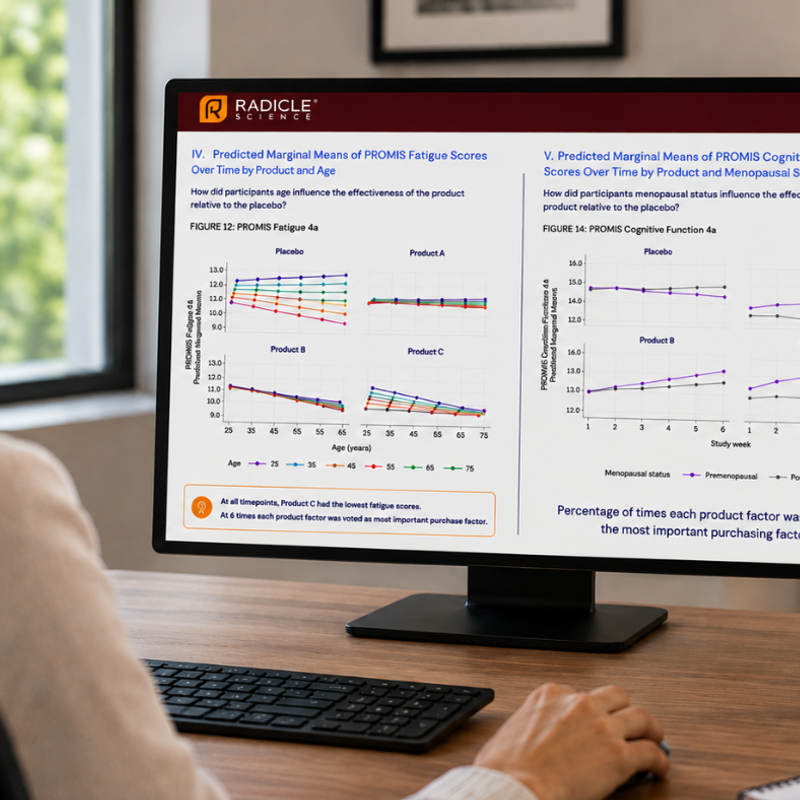
A product may show a modest overall effect and a much stronger effect in a defined subpopulation. Another product may perform well for one use case and weakly for another. A formulation may work, but not at the dose or format the company expected.
Those findings are not side notes. They are the raw material of a stronger wellness innovation pipeline. It is the data the average result almost buried.
Subpopulation analysis can help a company identify its most responsive audience, sharpen its positioning, support more precise claims, or develop the next product for a group the original strategy overlooked. The wellness innovation pipeline becomes richer when companies treat every trial as a source of forward-looking intelligence, not just a backward-looking verdict.
This is why a neutral or unexpected trial result should not be considered a failure. It can be the beginning of a better pipeline. The subgroup your top line almost missed may be the market you have not found yet.
Evidence-Led Innovation: Disciplining the Product Development Process
New product development often begins with assumptions. Consumers want this ingredient. This format will win. This benefit will resonate. This category is ready for disruption. This claim will separate us from competitors.
Some assumptions are right. Some are expensive to be wrong about.
Evidence-led innovation does not kill entrepreneurial instinct. It disciplines it. It gives teams a way to name their assumptions, test the most important ones, and decide what deserves more capital before the business commits too far.
That changes the product development conversation. Instead of asking, "Can we launch this?" teams ask, "What would make us confident enough to launch this?" Instead of asking, "Can marketing tell this story?" they ask, "What story does the evidence support?"
Evidence-based product development makes that shift structural, not cultural. Once the evidence is in, the question of whether to commit answers itself. The bar moves. The quality of decisions moves with it.
Aligning Teams Around a Common Operating Language
Without a shared evidence standard, every function optimizes around a different signal. Clinical evidence in wellness innovation does something most strategy documents cannot. It gives the whole organization the same reference point.
Marketing follows consumer desire. Product follows formulation novelty. Sales follows retailer feedback. Finance follows margin. Leadership follows speed.
Those signals are all useful. They are not all equal.
A clinical-grade evidence base gives teams a common reference point. What did the trial show? What did it not show? Which outcome matters most? Which claim can the company defend? Which segment responded? What should be tested next?
That shared language helps companies make better decisions across science, product, marketing, commercial strategy, finance, and the executive team. It turns evidence from a document into an operating discipline.
The Long-Term ROI of Clinical Evidence in Wellness
In a crowded wellness market, evidence is becoming a competitive requirement. Brands need evidence that can support claims, withstand scrutiny, and earn trust. That alone makes clinical research valuable.
But the stronger advantage is compounding learning.
A company that embeds clinical research into its wellness innovation strategy consistently builds something its competitors cannot replicate: a proprietary evidence base. That data informs claims today. It shapes the next product tomorrow. It tells you which market to enter and which hypothesis to test next.
Competitors can copy packaging. They can mimic positioning. They can chase the same trend. They cannot replicate years of accumulated evidence about what works, for whom, and why.
That is the moat. Not one study. The evidence engine.
The future belongs to companies that can prove and learn
The wellness industry has run for too long on trust, hope, and claims that outpace the evidence behind them. That era has ended.
The companies that win next will not be the ones that treat research as a box to check after the strategy is set. They will build evidence into the strategy itself.
They will use trials to close the evidence gap. They will use subpopulation analysis to find the market the top line almost missed. They will use real-world evidence to decide which populations deserve the next investment, and which hypotheses to test after that.
The clinical trial ROI in wellness compounds over time. Clinical evidence in wellness innovation is not the end of a product story.
Proof is not optional anymore. Evidence-led innovation is not a research philosophy. It is a competitive strategy. The brands building it now are the ones their competitors will be trying to catch.
Frequently Asked Questions
What is the role of clinical evidence in wellness innovation?
Clinical evidence in wellness innovation is a decision-making infrastructure. Not just a validation tool. It tells executives which products to invest in, which formulations to refine, and which markets have real demand backed by measurable efficacy. It replaces assumptions with data that can be defended in any room.
How does a clinical research wellness strategy reduce innovation risk?
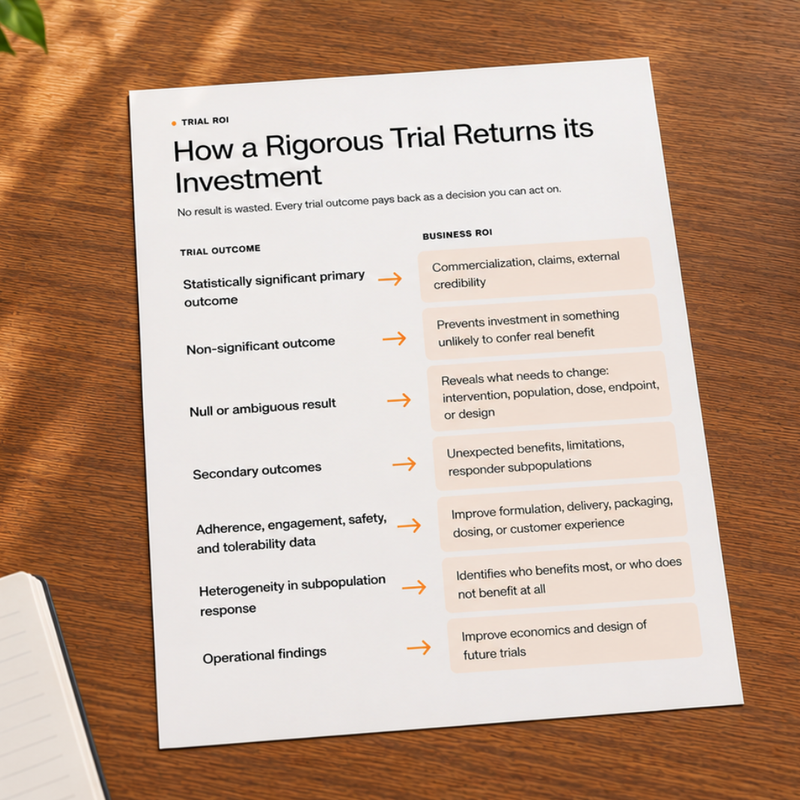
A clinical research wellness strategy makes risk visible before the capital is committed. By generating reliable data early, companies can identify which directions have strong evidence behind them and retire weak assumptions before they become expensive product failures. The trial that stops the wrong bet early pays for itself.
What is evidence-led innovation in the wellness industry?
Evidence-led innovation is a product development approach where clinical data guides decisions at every stage, from hypothesis through formulation, launch, and pipeline planning. Rather than treating research as a post-development checkpoint, evidence-led innovation embeds the evidence engine into the earliest stages of the product strategy.
How do wellness companies use subpopulation analysis in their innovation pipeline?
Subpopulation analysis reveals what the top-line result almost buries. Within any trial, specific cohorts, defined by demographic, behavioral, or baseline characteristics, often respond far more strongly than the average. Those groups define the wellness innovation pipeline: which formulations to refine, which audiences to prioritize, and which hypotheses to test next.
What is the clinical trial ROI for wellness brands?
The clinical trial ROI in wellness extends well beyond claim support. It includes sharper capital allocation, reduced cost of failed product launches, stronger competitive differentiation, and a compounding evidence base that informs every future investment. Companies that generate evidence consistently build a proprietary asset their competitors cannot replicate without running their own trial.