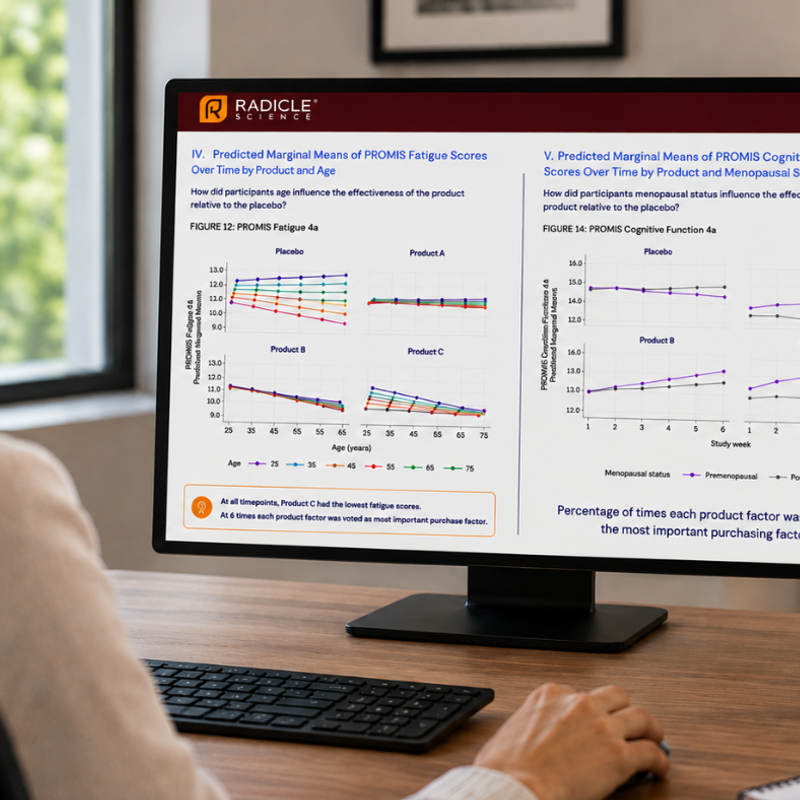
A decentralized (virtual) clinical trial (DCT) is designed to evaluate a supplement in real-world conditions using validated methods. Instead of relying on physical study sites, participants engage remotely, allowing for broader reach, continuous data capture, and more scalable evidence generation. While the experience differs from traditional trials, if designed well with the right partner, the underlying structure remains rigorous.
Study Design: Defining Outcomes and Endpoints
After confirming regulatory, safety and quality compliance, the process begins with study design, where outcomes, population, and methodology are defined. This includes selecting endpoints (e.g., validated surveys or biomarkers delivered via home kits, wearables, etc.), and aligning on the intended use of results.
Regulatory Setup and IRB Approval
Next is regulatory and study setup, including Institutional Review Board (IRB) approval and registration on public databases (e.g., ClinicalTrials.gov). At the same time, study materials, digital platforms, and logistics are prepared.
Virtual Recruitment and Enrollment
Once the study is ready to launch, recruitment and enrollment begin. Participants are identified and screened through digital channels. Eligible participants provide consent, complete baseline assessments, and are onboarded into the study.
Remote Product Distribution and Study Execution
Following enrollment, blinded product distribution and study execution take place. Participants receive the supplement directly at home, along with instructions. They follow the protocol independently, while engagement systems (e.g., reminders, progress tracking) support adherence. Data is collected through a combination of self-reported inputs and digital measurements over time.
Data Analysis and Powered Outcomes
After the study period ends, data collection is finalized and analyzed. This includes cleaning the dataset, evaluating powered outcomes, and identifying any exploratory insights or subpopulation trends.
Reporting and Application of Results
The final stage is reporting and application, where results are translated into structured outputs such as reports, datasets, case studies, or publications. Brands can then use outputs to support claims, inform product strategy, and guide future research.
Key takeaways:
- Decentralized trials offer an alternative to site visits with remote, digitally enabled participation
- Participants engage from home, enabling broader and more diverse populations
- Engagement systems support adherence and longitudinal data capture
- The study follows a structured pathway: design → setup → recruitment → execution → analysis → reporting
- Results can support claims, inform innovation, and contribute to ongoing evidence generation
Frequently Asked Questions
What is a decentralized clinical trial for a supplement?
A decentralized clinical trial (DCT) for a supplement is a virtual study that evaluates supplement efficacy in real-world conditions, with participants engaging remotely rather than visiting physical sites. It uses validated methods including digital surveys, wearables, and home-based biomarker collection. The approach enables broader population reach and more scalable evidence generation than traditional site-based trials.
How does a decentralized trial differ from a traditional clinical trial?
A decentralized trial replaces physical site visits with remote participation, using digital tools for recruitment, consent, data collection, and engagement. Traditional trials require participants to attend a site, which limits reach and population diversity. Decentralized clinical trials capture data from real-world use, producing real-world evidence that is more representative of everyday conditions.
What types of data are collected in a decentralized supplement study?
Data collection in a decentralized supplement study typically includes validated self-reported measures such as surveys and patient-reported outcomes, as well as digital measurements from wearables or home-based biomarker kits. Engagement systems track adherence throughout the study period. This combination of data sources supports powered outcomes and enables subpopulation trend analysis.
What are powered outcomes in a clinical trial?
Powered outcomes are study endpoints designed and sized to reliably detect meaningful effects with statistical confidence. In a supplement clinical trial, identifying powered outcomes requires upfront decisions about sample size and endpoint sensitivity. Evaluating powered outcomes at analysis distinguishes strong clinical evidence from exploratory findings.