“Gold standard rigor” is commonly used in clinical research to describe study approaches that produce reliable, interpretable evidence while minimizing bias and alternative explanations for an observed effect. For consumer health products, that rigor matters both for scientific understanding and for the strength of the evidence supporting health-related claims.
The Federal Trade Commission (FTC) requires claims to be supported by competent and reliable scientific evidence. The amount and type of evidence required depends on the specific claim, but for health-benefit claims, the FTC generally expects randomized, controlled human clinical testing. Features such as an appropriate control group, randomization, double-blinding when feasible, sufficient sample size and study duration, appropriate outcome measures, and sound statistical analysis all strengthen the reliability of the evidence.
At its core, rigor is about designing a study so that the results can answer with confidence the question being asked. But a rigorous study does not automatically substantiate every possible claim. The product, dose, and formulation tested, population studied, outcomes measured, study duration, and magnitude of the observed benefit must align with what is ultimately communicated to consumers. Evidence should also be considered within the broader body of relevant research rather than interpreted in isolation.
Importantly, these features of rigorous research do not inherently require a traditional site-based clinical trial. Decentralized and technology-enabled studies can execute core features such as randomization, blinding, placebo control, prespecified outcomes, and rigorous analysis while allowing research to reach broader populations and capture outcomes in participants’ everyday lives.
For health-product research, the goal is therefore not simply to conduct a clinical study. It is to design the right study to produce trustworthy evidence for the specific questions the data are intended to answer.
“Gold standard rigor” in clinical research refers to study designs that produce reliable, unbiased, and reproducible evidence. In the context of consumer health products, rigor is not only a scientific standard—it is directly tied to regulatory expectations, particularly those established by the Federal Trade Commission (FTC) for advertising and claim substantiation.
The FTC requires that health-related claims be supported by “competent and reliable scientific evidence.” This is generally defined as evidence derived from well-controlled human clinical studies that are appropriate for the claim being made. In practice, this often aligns with features of traditional gold standard trials, including randomization, blinding, control groups (such as placebo), and adequate statistical power.
At its core, rigor is the combination of methodological control, statistical validity, and data integrity. These elements reduce bias and increase confidence that observed effects are attributable to the intervention. However, rigor must also be aligned with the specific claim context—meaning the study design, endpoints, and population must directly reflect what is being communicated in the market.
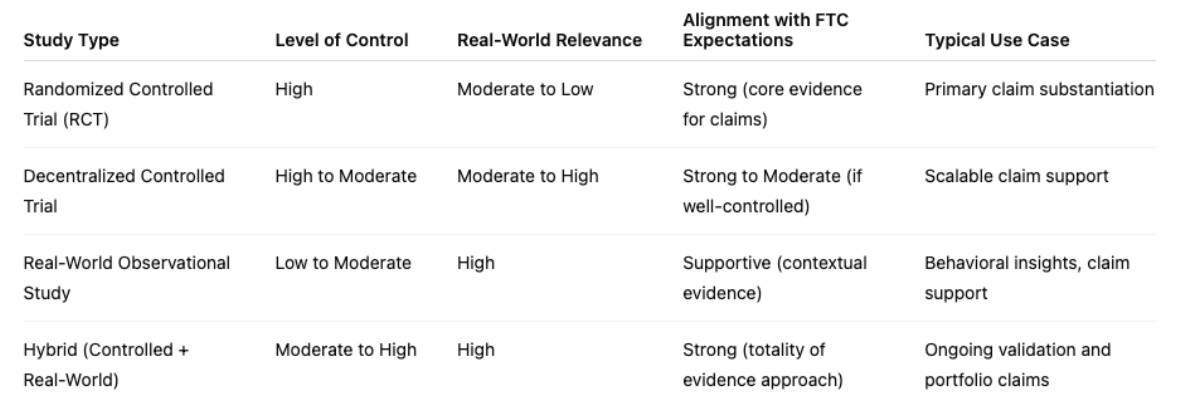
Importantly, FTC standards do not mandate a single study type, but they do require that the totality of evidence be sufficient to support the claim. This creates a need for both controlled studies (to establish causality) and real-world or decentralized approaches (to demonstrate relevance and consistency across broader populations).
The comparison below illustrates how different study designs align with both scientific rigor and claim substantiation requirements:
A relevant reference point: https://www.supplysidesj.com/supplement-regulations/-clinically-proven-claims-are-out-national-advertising-division-recommendations-on-tru-niagen-upheld
Frequently Asked Questions
What is FTC claim substantiation for health and wellness brands?
FTC claim substantiation is the requirement that any health-related advertising claim be supported by competent and reliable scientific evidence. The FTC defines this as evidence derived from well-controlled human studies conducted and evaluated in an objective manner by qualified professionals. For wellness brands, this means clinical evidence must exist before a claim is made, not after.
What does gold standard clinical trial design mean for supplement claims?
A gold standard clinical trial for supplement claim substantiation is a randomized, double-blind, placebo-controlled study conducted on the actual product at the dose and in the population described by the claim. The FTC considers this design the most reliable form of evidence because it minimizes bias and alternative explanations for the observed effect. Other study types may contribute to the totality of evidence but typically carry less weight.
What clinical trial evidence does the FTC require to substantiate a health claim?
The FTC requires competent and reliable scientific evidence, which it defines as a flexible standard without a fixed formula for the number or type of studies required. For health-benefit claims, the FTC generally expects randomized, controlled human clinical testing. The study design, endpoints, population, dose, and duration must align with what the brand communicates to consumers.
Can decentralized clinical trials meet FTC clinical trial requirements?
Yes. FTC standards do not mandate a traditional site-based trial. Decentralized and technology-enabled studies can satisfy FTC clinical trial requirements by executing core features: randomization, blinding, placebo control, prespecified outcomes, and rigorous statistical analysis. Decentralized trials have the additional advantage of reaching broader, more representative populations and capturing outcomes in participants' everyday environments.