What is subpopulation analysis and why does it matter for wellness companies?
Most wellness companies still use clinical research too narrowly. They run a study, look for the top-line result and extract the broadest possible proof point. Then they hand it to marketing.
That's not wrong. It's just incomplete.
There's a bigger opportunity here that goes beyond not only proving that a product works. It's finding out for whom it works best and building the business around that signal.
Subpopulation analysis for wellness brands changes the commercial playbook.
For decades, the wellness industry has treated clinical data as a claims substantiation tool. A way to support the language on the website, the label, the sales deck, or the retail presentation. Clinical proof still matters. More than ever. But in a market where consumer acquisition costs are high, retention is fragile, and sameness is everywhere, proof cannot stop at validation.
It has to become strategy.
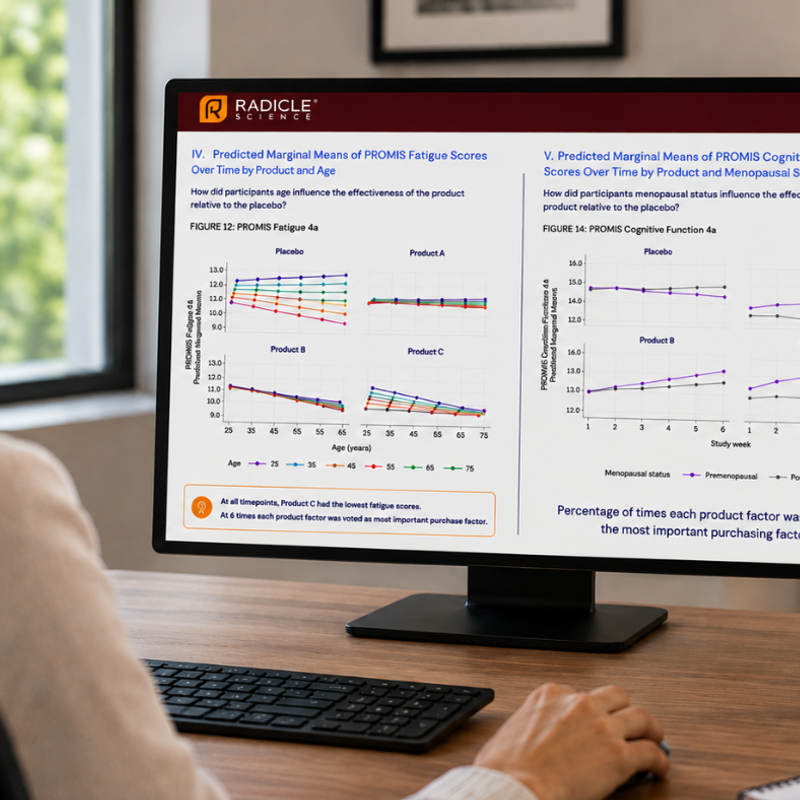
Large-scale clinical research can do more than answer whether the average participant improved. It can identify the groups that responded more strongly, relative to placebo within that group, the outcomes that mattered most to them, and the conditions under which the product created the clearest value.
That is not a statistical footnote. That is a growth signal.
The Average Consumer Is Not Your Customer
The wellness industry loves broad promises.
Better sleep. Less stress. More energy. Faster recovery. Improved focus.
Those promises are simple. They are also crowded. Every category has too many products saying nearly the same thing to nearly the same consumer.
The problem is not only marketing fatigue. The problem is that the average result can hide the most valuable finding in the study.
A product might show a modest or no effect across the full study population. But inside that population, a specific group, or cohort, may respond far more strongly. Women. Active consumers. Adults in a defined stage of life. Consumers with a certain baseline need. People with a specific usage pattern.
The top line tells you what happened on average.
The subpopulation from clinical research tells you where the business should look next.
That distinction matters. Brands do not grow by marketing to averages. They grow by finding the people most likely to care, convert, stay, and tell others why the product worked for them.
Subpopulation analysis helps identify those people.
From Proof Point to Precision Go-To-Market Growth
Many brands ask one question of their clinical data: What can we say?
Leading brands ask a sharper question: Who should we prioritize?
That shift is the foundation of a clinical data segmentation strategy. It turns research from a defensive asset into a commercial engine.
When a trial identifies a stronger-response cohort, that group becomes more than a demographic segment. It becomes a higher-conviction audience. These are the consumers with a greater likelihood of experiencing the product's value. That makes them more likely to convert. More likely to repurchase. More likely to leave a credible review. More likely to become the customer the brand was actually built for.
This is the commercial power of subpopulation analysis.
"The future for brands is not one product, one claim, one average consumer. The future is precision: knowing which interventions work, for which people, under which conditions. We can finally get there because of reliable subpopulation analysis enabled by large diverse datasets. This connects the science to the business by showing where the strongest product-market fit lives. Which can shape targeting, acquisition, retention, and innovation. It turns evidence from a one-time study into a strategic asset that delivers ROI year after year."
Dr. Jeff Chen, CEO and co-founder, Radicle Science
It informs product positioning. It sharpens message architecture. It guides acquisition strategy. It improves onboarding and retention. It can tell innovation teams where to invest next.
The result is not narrower marketing. It is smarter marketing.
Broad claims create broad campaigns. Stronger response signals create precision.
Supplement Brand Differentiation Starts With a Clearer Audience
A generalized benefit can build credibility. It rarely creates urgency.
Consumers do not only ask, Is this product backed by science? They ask, even if silently, Is this for someone like me?
Subpopulation analysis helps brands answer that question with more discipline.
If women show a stronger response pattern, the brand can build messaging around the lived context of that audience. Instead of vague “for women” language, it's specificity. Daily stress load. Changing recovery needs. Sleep disruption. Hormonal transition. The real conditions shaping how a consumer evaluates whether a product belongs in her routine.
If active consumers show a stronger signal, the message shifts again. The product is not just about recovery support. It is about consistency. Training readiness. Bouncing back. Staying in rhythm. The benefit becomes connected to the consumer's identity and behavior.
If a stage-of-life cohort responds more strongly, the brand has another route to relevance. The message can speak to the moment when sleep, energy, focus, or recovery no longer feel automatic. That kind of framing works because it names a change the consumer already feels.
The product does not become many different products.
The story becomes more precise.
That is the difference between a clinical claim and a commercial strategy.
Segmented Messaging Is Not Guesswork When the Data Leads
Without subpopulation insight, segmented marketing often starts with assumptions.
Marketing teams infer audiences from category trends, customer personas, retail data, or competitive positioning. Those inputs matter. But they do not prove product fit.
Clinical data adds a different layer.
It shows which groups actually experienced stronger outcomes. That gives commercial teams a better foundation for building segmented messages.
A clinical data segmentation strategy changes the question from “Which audience can we sell this to?” to “Which audience has the clearest reason to believe?”
That changes the entire brief.
For a women-focused segment, the lead message might center on resilience, recovery, sleep, or stress load depending on what the data showed. For an active nutrition segment, the message might center on performance durability, recovery routines, or consistency. For a stage-of-life segment, the message might center on adapting to changing needs with clinical-grade evidence behind the product.
Each audience gets a sharper front door.
The brand still needs compliant language. It still needs discipline around what the trial did and did not show. But it no longer has to rely on generic benefit statements alone.
It can build messaging around demonstrated patterns of response.
That's how clinical research becomes useful to the commercial team before the next campaign launches.
Wellness Brand Acquisition Strategy: Targeting Higher-Density Channels
Most acquisition strategies optimize for reach, cost, and conversion.
Those metrics matter. But they can mislead.
The cheapest click is not always the best customer. A channel can produce efficient traffic and still bring in low-fit buyers who churn after one purchase. That is not growth. That is rented attention.
Subpopulation analysis for supplement brands adds a better question: Where do our strongest-fit consumers already spend time, seek guidance, and make decisions?
If the strongest signal appears among women, the brand may prioritize women's wellness communities, practitioner-adjacent education, lifecycle-focused newsletters, podcasts, specialty retail, or creator partnerships with real credibility.
If the signal appears among active consumers, the channel mix may shift toward fitness creators, endurance communities, gyms, recovery studios, sports nutrition retailers, training apps, or athlete-led content.
If the signal appears by stage of life, search and education may matter more. These consumers are often actively researching what is changing and what to do about it. Long-form content, expert interviews, targeted email journeys, retailer education, and community-based trust channels can outperform broad awareness campaigns.
The goal is not more channels.
The goal is higher-density channels: places where the people most likely to benefit are already paying attention.
That is a better use of acquisition spend. It is also a better foundation for retention.
Retention Starts Before the First Purchase
Retention is usually treated as a post-purchase problem.
It is not.
Retention starts with product fit.
A consumer who is more likely to experience a meaningful benefit is more likely to stay with the product long enough to build a routine. A consumer who sees herself clearly in the message is more likely to understand how the product fits her life. A consumer who enters through the right channel with the right expectation is less likely to churn because the promise was too broad, too vague, or too disconnected from her real need.
Subpopulation analysis improves retention because it helps brands acquire better-fit users in the first place.
Then it can shape the lifecycle strategy after purchase.
A women's wellness audience may need education that reflects daily stress, sleep disruption, or recovery needs. An active nutrition audience may need content around timing, consistency, and routine stacking. A stage-of-life audience may need reassurance, education, and a clearer explanation of what to expect over time.
The product experience should not end at checkout.
The data should guide what happens next.
Supplement Brand Differentiation: The Next Advantage Is Knowing Where to Focus
Supplement brands do not need more generic evidence.
They need sharper evidence.
They need to know which products deserve investment. Which audiences deserve priority. Which claims hold. Which messages are likely to land. Which channels attract people who will not only buy, but stay.
That requires scale.
Small studies can miss the patterns that matter. Large, real-world trials create the resolution needed to see meaningful differences across subpopulations. The signal gets clearer because the study is built to capture variation, not flatten it.
"Averages can hide as much as they reveal. If you only focus on the average result, you may miss who benefited, who didn't, and why. And if the study only includes a small group of similar people to begin with, those types of differences may not even have a chance to show up. To understand how something will actually work for a real person, you need a wide enough range of people, in large enough numbers that you can actually see meaningful differences in how they respond."
Kaitlyn White, Senior Director of Scientific Affairs, Radicle Science
The industry has spent too long treating clinical research as a substantiation checkbox.
That era has ended.
The next generation of winning brands will use clinical data to decide not only what they can say, but where they should focus. Supplement brands will use subpopulation analysis to find the consumers more likely to respond, build a clinical research go-to-market wellness strategy that speaks directly to those consumers, and invest in acquisition channels where those consumers already are.
The top line still matters.
But the sub-group your top line missed may be your real market.
And the brands that find that market first will have the advantage.
Frequently Asked Questions
What is subpopulation analysis for supplement brands?
Subpopulation analysis for supplement brands is the process of identifying which consumer cohorts within a clinical trial responded more strongly to a product. Rather than relying on top-line average results, it reveals which specific groups experienced the most meaningful outcomes, giving commercial and marketing teams a sharper foundation for positioning, targeting, and go-to-market strategy.
How does clinical data improve supplement brand differentiation?
Clinical data improves supplement brand differentiation by revealing who a product actually works for, not just whether it works on average. When brands use subpopulation analysis to identify higher-response cohorts, they can build more precise messaging, target acquisition channels where those consumers already are, and create a clearer product-market fit story that competitors without that data cannot replicate.
What is a precision go-to-market strategy for wellness brands?
A precision go-to-market strategy for wellness brands uses clinical subpopulation data to define which consumer segments to prioritize first, what messaging will resonate with those segments, and which acquisition channels those consumers already use. It moves brands away from broad positioning based on category assumptions toward targeted strategies grounded in observed clinical response.
How does subpopulation analysis improve supplement brand retention?
Subpopulation analysis improves supplement brand retention by helping brands acquire better-fit consumers in the first place. When acquisition channels, messaging, and positioning are aligned with the cohorts most likely to experience meaningful product benefits, those consumers are more likely to build a routine with the product and stay long-term.
How do wellness brands use clinical data for acquisition channel strategy?
Wellness brands use clinical data for acquisition channel strategy by matching the characteristics of their strongest-response cohorts to the channels where those consumers already spend time. If a trial shows stronger outcomes in women at a particular life stage, for example, the brand can prioritize channels with high density of that audience rather than optimizing for broad reach and lowest cost per click.