What is subpopulation analysis in clinical research? Subpopulation analysis evaluates how specific groups within a study respond to an intervention, rather than relying solely on the overall result. Where aggregate findings show the average outcome across all participants, subpopulation analysis asks a more precise question: within this group, did the product outperform the placebo?
Aggregate results can mask meaningful variability. A product that shows a modest overall effect may perform substantially better for a specific demographic, and understanding who responds, and why, is often where the most commercially useful signal lives.
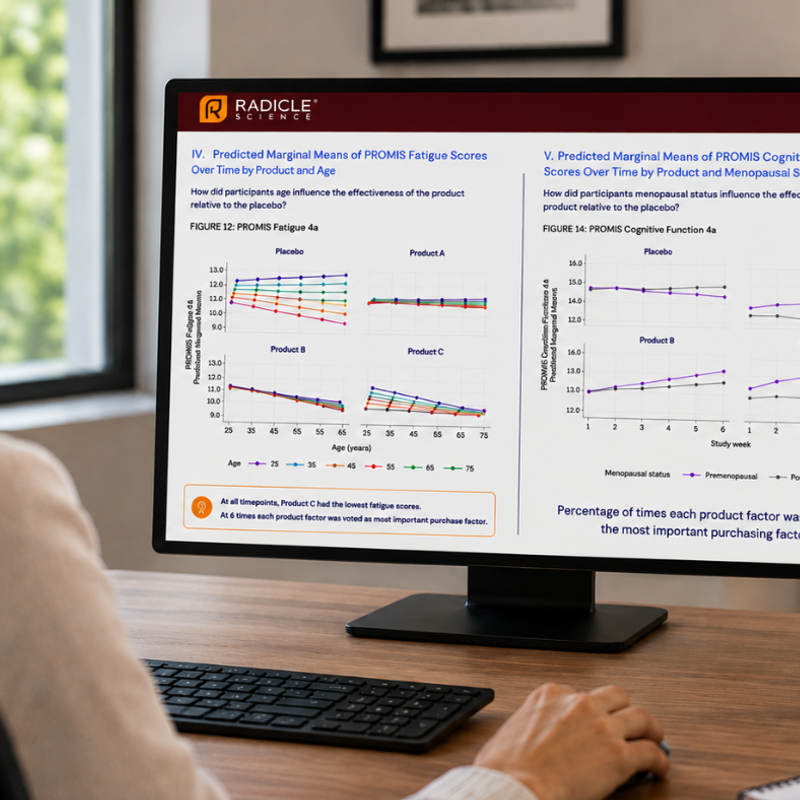
Radicle's standard subpopulation analysis examines five demographic variables: sex at birth, age, BMI, menstrual status (premenopausal, perimenopausal, postmenopausal), and severity of baseline impairment. These are analyzed using the same longitudinal mixed-effects regression model as in the core trial, with one addition: a subgroup interaction term to test whether the demographic variable moderated the product's effect relative to placebo. This is not a simple data cut. It is the same rigorous statistical approach applied to a more specific question.
These analyses are delivered in Radicle's Explorer Report, one of three reports included in every standard study package. They are exploratory; the study is not powered or pre-specified around subgroup questions, which means findings should be treated as signals, not standalone evidence. The right framing: "this group showed a response in our study," "exploratory finding," "signal of effect," or "an area for further research." A statistically significant subpopulation finding is a real result from real placebo-controlled data. It warrants confirmation in a purpose-built study before being used to substantiate a targeted claim.
That said, these signals have real strategic value. They inform which populations to prioritize in the next trial, how to position the product for specific audiences, and where precision wellness messaging is warranted. Several Radicle clients have acted directly on subpopulation findings, commissioning follow-on studies, publishing white papers, and reshaping their go-to-market strategy around the groups that responded most strongly.
The value of subpopulation analysis in clinical trials compounds over time. The consistency of Radicle's approach matters here: the same standard subpopulation variables are run across every study by default. That means findings are comparable across trials and can build into a cumulative picture of who benefits and under what conditions.
Key Takeaways
Subpopulation analysis asks who responds, not just whether the product works overall. Aggregate results can miss the groups where an intervention performs most strongly. Subpopulation analysis surfaces those signals.
Radicle's standard variables are sex at birth, age, BMI, menstrual status, and baseline condition severity. The same set is run across every study, making findings comparable over time.
The method is rigorous. Radicle uses the same mixed-effects regression model as the core analysis, with a subgroup interaction term added. This is not a data cut. It is a proper statistical test.
Findings are exploratory, not claim-ready on their own. The study is not powered for subgroup questions. A significant finding is a real signal, but confirmation in a purpose-built study is required before it supports a targeted claim.
Use the right vocabulary. "Signal of effect," "exploratory finding," "this group showed a response in our study," "an area for further research." Not "proven to work for."
Subpopulation insights drive the next study. The most valuable use of subpopulation analysis in clinical trials is often designing a follow-on trial, one that is powered and pre-specified around the group that showed the strongest response.
Frequently Asked Questions
What is subpopulation analysis in clinical research?
Subpopulation analysis in clinical research evaluates how specific groups within a study respond to an intervention, rather than relying solely on the overall average result. It asks whether a defined demographic, such as women, older adults, or people with a specific baseline condition, showed a stronger response to the product compared to placebo. It is how brands discover where their product works best.
How is subpopulation analysis different from aggregate results?
Aggregate results show the average outcome across all study participants. Subpopulation analysis breaks that down by specific groups. A product can show a modest or non-significant overall effect while producing a much stronger response in a defined subgroup. Aggregate results can mask that signal. Subpopulation analysis surfaces it.
Are subpopulation findings claim-ready?
Not on their own. Subpopulation findings from a standard trial are exploratory because the study is not powered or pre-specified around subgroup questions. A statistically significant subpopulation finding is a real signal from real placebo-controlled data, but it requires confirmation in a purpose-built, adequately powered study before it can support a targeted claim. The right framing is 'signal of effect' or 'exploratory finding,' not 'proven to work for.'
What subpopulation variables does Radicle analyze?
Radicle's standard subpopulation analysis examines five demographic variables: sex at birth, age, BMI, menstrual status (premenopausal, perimenopausal, postmenopausal), and severity of baseline impairment. The same set is run across every study by default, which means findings are comparable across trials and can build into a cumulative picture of who benefits and under what conditions.
How does Radicle Science's subpopulation analysis method work?
Radicle uses the same longitudinal mixed-effects regression model as the core trial, with one addition: a subgroup interaction term that tests whether the demographic variable moderated the product's effect relative to placebo. This is not a simple data cut. It is the same rigorous statistical approach applied to a more specific question, which is what makes the findings credible rather than exploratory data mining.